How to choose a PPC agency in the UK, and what PPC management should cost.
Choose a PPC agency that puts its fee on the page, leaves the ad account in your name, tracks calls and forms before it spends, works month to month and tells you who runs your account. UK small businesses typically pay £500 to £1,500 a month in management on top of ad spend.
Most businesses pick a PPC agency the same way: a referral, a Google search, a couple of sales calls, then the one that sounded most confident. That is how good businesses end up locked into a year of reports full of clicks. This guide covers what UK PPC agencies charge, how their pricing models work, and the checks that tell you whether an agency will make you money. If you only need one answer, the PPC agency FAQs answer each question in a few paragraphs.
What a PPC agency actually does
PPC (pay per click) means paying for ads by the click. In the UK that mostly means Google Ads, with Microsoft Ads and Meta Ads alongside. A PPC agency, or a Google Ads agency, builds and runs those campaigns for you. The work that moves results is unglamorous and weekly:
- Choosing the searches worth paying for, and blocking the ones that waste money with negative keywords.
- Writing and testing ads, and pointing them at pages built to turn clicks into calls.
- Setting bids and budgets, and moving money towards the campaigns that bring enquiries.
- Tracking calls, forms and bookings so every decision rests on enquiries, not clicks.
- Reporting what changed, what it cost and what comes next.
Ask any agency how much of that it does each month for your fee. The answer tells you most of what you need to know.
How much does a PPC agency cost in the UK?
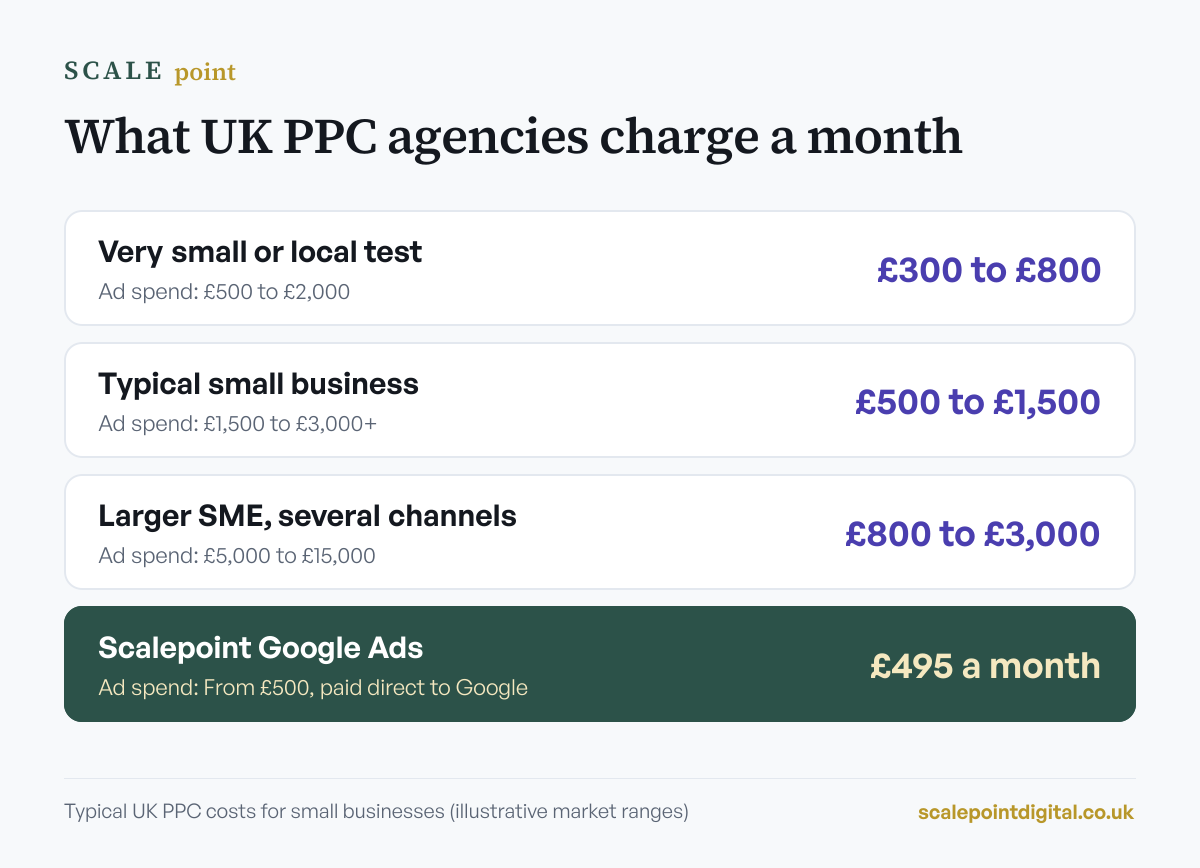
The management fee and the ad spend are two separate costs. The fee pays the agency. The ad spend goes to Google, Microsoft or Meta for the clicks. Typical UK small business figures look like this:
| Situation | Management fee | Ad spend | Total a month |
|---|---|---|---|
| Very small or local test | £300 to £800 | £500 to £2,000 | £800 to £2,800 |
| Typical small business | £500 to £1,500 | £1,500 to £3,000+ | £2,000 to £4,000+ |
| Larger SME, several channels | £800 to £3,000 | £5,000 to £15,000 | £5,800 to £18,000+ |
| Scalepoint Google Ads | £495 a month | From £500, paid direct to Google | From about £1,000 |
Before you compare fees, check for two hidden costs. A setup fee can add hundreds of pounds before a single ad runs. A markup on ad spend means part of your budget never reaches Google. We charge neither: every pound of ad spend goes to the platform at cost, and every fee is on our pricing page.
PPC agency pricing models compared
| Model | How it works | Best for |
|---|---|---|
| Flat retainer | The same monthly fee whatever you spend on ads | Most small businesses: predictable, and no reason to push spend up |
| Percentage of spend | Usually 10 to 20 per cent of monthly ad spend | Larger accounts, as long as the fee has a cap |
| Hybrid | A lower base fee plus a percentage or bonus | Businesses that want some of the fee tied to growth |
| Performance-based | Fee per lead or sale, or tied to a target cost | Only accounts with tracking both sides trust |
Percentage fees grow quietly. At £5,000 a month in ads, 15 per cent is £750; at £10,000 it is £1,500 for much the same work. Ask every agency for the effective monthly fee at the budget you plan to spend, not just the headline rate.
How much ad spend do you need to start?
For most UK small businesses, £500 a month is the floor for Google Ads to produce useful data, and £1,000 to £2,500 a month gives a fair test of one service in one area. Below that, the management fee can swallow most of the budget. Our minimum ad spend is £500 a month. Start narrow: one service in the towns you most want work from, with a proper budget, teaches you more than ten services sharing the same money. In a county like Staffordshire, that means Google Ads in Stoke-on-Trent and Staffordshire targeted town by town, not one county-wide campaign. Our guide to Google Ads budgets for trades works through the sums.
How to choose a PPC agency: eight checks
1. Define what a profitable lead is worth to you
Work out your average job value, how many enquiries you win, and the most you can pay for one. A good agency asks for these numbers before it proposes a budget. One that talks only about clicks and impressions has not thought about your margin.
2. Ask for proof from businesses like yours
Look for recent examples from your sector or a similar local service business, with cost per enquiry or cost per booked job over time. A national e-commerce success story tells you little about filling a plumber’s diary in Leeds.
3. Check Google Partner status in Google’s own directory
Search for the agency at google.com/partners rather than trusting a badge on its website. Partner status shows the agency meets Google’s spend, performance and certification requirements. It does not judge how well the agency will run a small account, so treat it as one check among eight.
4. Meet the person who will run your account
Senior people often pitch while junior staff do the work. Ask who will manage your account each week, how much experience they have, and how many other accounts they look after.
5. Keep the ad account in your name
Your business should own the Google Ads account, the billing, Google Analytics and the conversion tracking from day one. The agency should work in it through access you grant, usually by linking it to its manager account. If you leave, you keep every keyword, ad, search term and year of data. At Scalepoint you own every account from day one.
6. Insist on tracking before spend
Calls, form enquiries and bookings should all register as conversions, and someone should test them before the budget goes live. Without tracking, Google bids blind and nobody can tell which keywords pay. Our Google and tracking setup is a £300 one-off if you want the foundations built properly first.
7. Read the contract before the proposal
Check the minimum term, the notice period, any exit fees and how quickly the agency hands over access. PPC results show within weeks, so a rolling monthly agreement is fair to both sides. We work month to month with 14 days’ notice and no exit fees.
8. Ask how they would run your account
A good agency can explain, in plain English, how it would structure your campaigns, which searches it would target first, how it would keep brand searches separate from new customers, and what it would test in month one. Vague answers now mean vague reports later.
10 questions to ask a PPC agency before you sign
- Is the management fee separate from ad spend? You need both numbers to know the real monthly cost. Ask for the fee at the budget you plan to spend, not just the headline rate.
- Is there a setup fee or a markup on ad spend? Either one takes money out of your budget before an ad runs. A markup means part of your spend never reaches Google.
- Will the ad account sit in my name from day one? The Google Ads account, billing, Analytics and tracking should all belong to your business. The agency works in them through access you grant.
- Which conversions will you track? Calls, form enquiries and bookings should all count. Without them, Google bids blind and nobody can tell which keywords pay.
- Will you test the tracking before you spend? One test call and one test form, checked in Google Ads, catches most problems. Ask who signs it off.
- Who will run my account each week? Senior people often pitch while junior staff do the work. Ask for the name, their experience and how many other accounts they handle.
- What work happens each month for the fee? Expect search term reviews, negative keywords, ad tests, bid and budget changes and landing page advice. “Monitoring” on its own is not a service.
- What will the monthly report show? Ask to see a real example. It should lead with calls, enquiries and cost per enquiry, not clicks and impressions.
- What is the minimum ad spend for my market, and why? A good agency will tell you if your budget is too small to learn from. One that takes any budget is selling the fee.
- What is the notice period, and what happens when I leave? Look for a rolling monthly agreement, no exit fees and a clear handover of access. Your account and data should stay with you either way.
7 red flags when hiring a PPC agency
- The ad account sits in the agency’s name. You lose the keywords, ads, search terms and conversion history when you leave. Insist on ownership in writing before any spend starts.
- They guarantee results. Nobody controls the Google auction, so a promised number of leads or a fixed cost per lead before the agency knows your market is a sales line.
- Reports show clicks, not enquiries. Clicks, impressions and click-through rate say nothing about booked work. A report without calls and form enquiries hides whether the money works.
- A 12-month contract with exit fees. PPC results show within weeks, so a long minimum term mainly protects the agency. Ask what you get in return for signing one.
- Pressure to raise spend before tracking proves the budget works. More budget on an account that cannot see its conversions just buys more unmeasured clicks.
- Fees hidden as a markup on ad spend. If the agency pays Google and invoices you a larger figure, part of your budget never reaches the platform. Ask to see the billing in your own account.
- Nobody can tell you who runs the account. If the person on the sales call disappears after signing and nobody can name your account manager, expect slow changes and generic reports.
How long should you give a PPC agency?
Ads can bring enquiries within days, but judge a new agency over about three months. Google needs a few weeks of conversion data to bid well, and the agency needs time to cut wasted searches and test ads. By month three your cost per enquiry should be falling. If month one brings no tracked enquiries at all, ask why straight away: broken tracking, the wrong keywords and weak landing pages are all fixable once someone spots them.
PPC agency, freelancer or do it yourself?
If your ad budget is under about £500 a month, running a small, tightly focused account yourself can make more sense than paying a fee that rivals the spend. A good freelancer suits a single channel at a modest budget. An agency earns its fee when you need tracking, landing pages and several channels working together, or want cover when one person is away. We compared the cheapest end of the market in Checkatrade vs Google Ads and PPC vs SEO for local business.
What Scalepoint’s Google Ads management includes
Our Google Ads management is £495 a month plus ad spend, with a £500 a month minimum ad budget paid direct to Google. There is no setup fee, no markup on spend, and the agreement runs month to month with 14 days’ notice. You own the ad account and all the tracking from day one. If you want Google and Meta together, our Spark plan is £750 a month plus ad spend. Every price sits on the pricing page, and we start with a free audit so you can see what we would change before you pay anything.
Sources
- Google Partners directory, Google.
- About conversion measurement, Google Ads Help.
- About manager accounts, Google Ads Help.
In summary
A good PPC agency puts its fee on the page, leaves the ad account in your name, tracks calls and forms before it spends and works on short terms. UK small businesses typically pay £500 to £1,500 a month in management on top of ad spend. Scalepoint’s Google Ads management is £495 a month plus ad spend, month to month with 14 days’ notice.
Want more guides like this in your Google Top Stories? Add Scalepoint as a preferred source.